
Trang chủSwimmingKatie Grimes and the 4:03.27 at NCAAs: A Short-Course Peak or a Signal of International Revival?
Katie Grimes and the 4:03.27 at NCAAs: A Short-Course Peak or a Signal of International Revival?
**Câu trả lời cốt lõi:** Katie Grimes thắng 400 yard hỗn hợp cá nhân tại dual meet NCAA Virginia – Florida với 4:03.27, hơn Leah Hayes 0,24 giây. Đây là thành tích dẫn đầu NCAA nhưng ở bể ngắn 25 yard, không quy đổi trực tiếp sang thành tích bể 50 m. **Dữ kiện chính:** - 4:03.27 là thời gian dẫn đầu NCAA ở 400 yard hỗn hợp cá nhân; biên độ thắng 0,24 giây trước Leah Hayes. - Grimes có 9:25.49 ở 1000 yard tự do, dẫn đầu NCAA, và 4:34.20 ở 500 yard tự do. - Thông số bể 50 m: 400 hỗn hợp 4:33.26; 800 tự do 8:19.10; 1500 tự do 15:55.69. - Nguồn không nêu split, thời gian phản xạ, tần số quạt tay hay quãng bơi mỗi chu kỳ. - Nhãn mùa giải 2026-27 trong nguồn gốc chưa được kiểm chứng độc lập. **Nguồn:** Bài phân tích Stage-2 về dual meet NCAA Virginia – Florida, dạng video feature có tài trợ; ngày công bố không được nêu trong nguồn gốc. **Hỏi đáp liên quan:** Hỏi: 4:03.27 có so sánh được với kỷ lục bể 50 m? Đáp: Không, vì bể ngắn 25 yard có 15 lần quay và không có phép quy đổi tuyến tính sang bể 50 m. Hỏi: Điểm mạnh kỹ thuật của Katie Grimes là gì? Đáp: Nền sức bền aerobic, thể hiện ở 1000 yard tự do 9:25.49 và 1500 m tự do 15:55.69, giúp cô quyết định cuộc đua ở lượt tự do cuối. Hỏi: Vì sao không nên gọi đây là sự hồi sinh quốc tế? Đáp: Vì thành tích dẫn đầu NCAA thuộc hệ bể ngắn, còn vị thế quốc tế được đo bằng thông số bể 50 m vốn chưa đạt ngưỡng dẫn đầu.
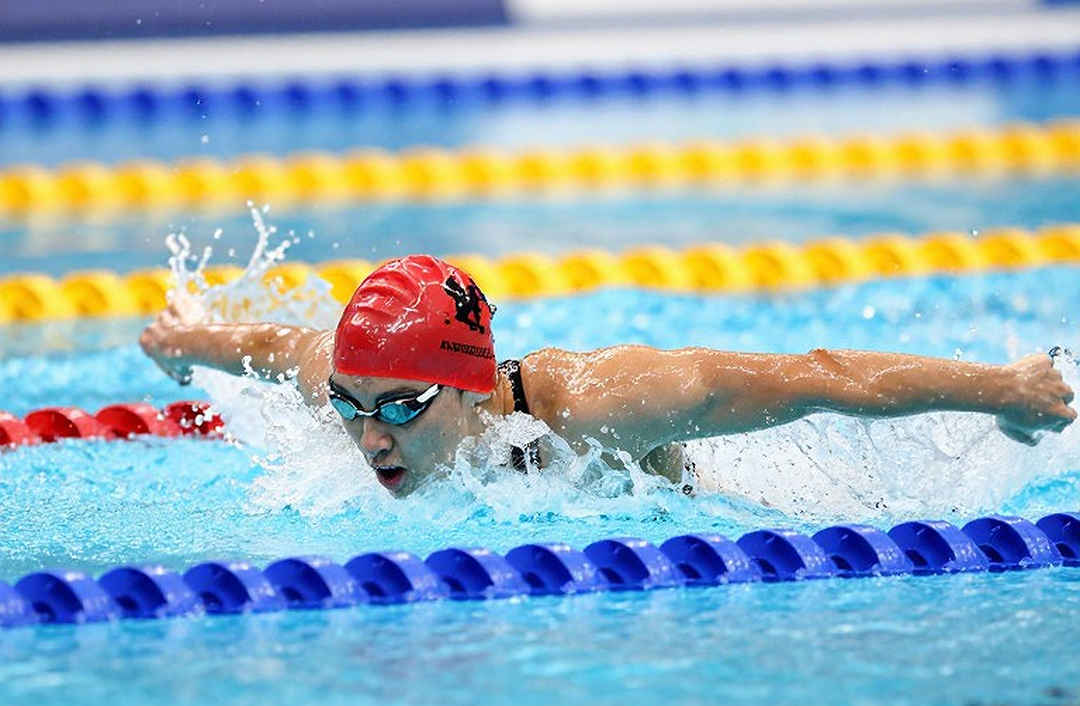
Katie Grimes stepped onto the blocks for the 400-yard individual medley in a Virginia versus Florida dual meet inside the NCAA season and left the pool with a 4:03.27. She beat Leah Hayes by exactly 0.24 seconds. The 4:03.27 was recorded as the fastest time in the entire NCAA system in the event at the time of publication. That is hard data, verifiable and reusable. But the interpretive layer attached to it, namely that the swim restores Grimes as a national-title contender and that she is on a comeback trajectory, belongs to the promotional-adjacent category and must be discounted before it enters any technical conclusion.
One point must be stated at the outset. The original item is a sponsored race-video feature about an in-season dual meet, not a confrontation at the peak of a training cycle. NCAA dual meets are internal competitions where teams mostly test volume and racing structure, not venues for exposing peak form. A fast time there is a data point on current conditioning and technical execution, not a declaration of international standing.
THE COORDINATE-SYSTEM PROBLEM
The central analytical issue is that the headline metric, 4:03.27 and NCAA-leading, sits in a short-course-yards coordinate system that has no direct conversion to the world-stage coordinate system in which Grimes's actual career is judged. The course for NCAA dual meets is short-course yards, 25 yards. Any comparison between 4:03.27 and long-course-metres figures is structurally invalid, not merely imprecise.
In a 25-yard pool, the 400-yard individual medley covers 16 lengths, which means 15 turns. Every turn and every post-turn breakout is an opportunity to save time that does not exist at the same frequency in a 50-metre pool. A swimmer with strong turning mechanics and the ability to hold speed off the wall benefits systematically. If Grimes wins in short course through structural advantage, that result does not automatically translate into 50-metre competitiveness.
The original article does not state the course. That omission should be recorded, even though the meet format allows short-course yards to be inferred with high confidence. The missing specification forces every technical conclusion down to medium confidence, because readers are not given the tools to check the claim themselves.
TECHNICAL PROFILE: A DISTANCE-BASED IMER, NOT A STROKE SPECIALIST
Grimes's technical profile is that of a distance-based individual medley swimmer, not a stroke-specialist one. The distinction is not academic. It determines how she wins and how she loses.
The numbers that shape the profile are a 9:25.49 in the 1000-yard freestyle, NCAA-leading, a 4:34.20 in the 500-yard freestyle, and a 15:55.69 in the 1500-metre freestyle in long course. That is the indicator set of an aerobic engine, not of a breaststroke or butterfly specialist. When a swimmer with this endurance base enters a 400 IM, the race structure tilts toward the final freestyle leg and toward resistance to cumulative aerobic decay across four strokes.
In other words, Grimes does not win through one dominant stroke. She wins through the closing 100 yards of freestyle and through her capacity to absorb aerobic decay. It is a durable winning model, but a conditional one. It requires her to keep the gap small enough through the first three legs for the freestyle leg to still matter. When an opponent opens a larger gap on the breaststroke or butterfly leg, the model loses its leverage.
THE SHORT-COURSE ADVANTAGE AND ITS LIMITS
Short course hands a double advantage to an endurance-based model. First, the high number of turns allows the swimmer to regenerate speed without continuous propulsive output. Second, the shorter distance between walls reduces cumulative mechanical fatigue. The result is that a swimmer with a strong aerobic base but without top-end absolute speed can still post very fast times.
The claim that an NCAA-leading time puts Grimes within reach of a national title is therefore well founded inside the short-course coordinate system. But the extended claim that this proves she is back in 50-metre contention is a category error. The two statements differ in kind, not only in degree.
In long course, her figures are far less compelling: 4:33.26 in the 400 IM and 8:19.10 in the 800 freestyle. Those are the times of a good swimmer who is not yet in the world-leading group at the moment the data was recorded. Reading 4:03.27 as evidence of international revival ignores the gap between the two measurement systems.
THE 0.24-SECOND MARGIN OVER LEAH HAYES
The 0.24-second margin over Leah Hayes is the only data point that describes the race directly. It indicates a close race, not a dominating performance. Across 15 turns, 0.24 seconds is roughly sixteen milliseconds per turn, a margin that sits inside the noise band of turning technique and breakout timing.
The result should therefore not be read as a statement about the class gap between the two swimmers. It does confirm that Grimes's winning model is operating as designed: she kept the race within control until the freestyle leg and decided it there. Against an opponent whose IM profile leans breaststroke, holding the margin small to the end is the necessary condition for the freestyle leg to matter.
No 50-yard splits are provided in the source. Without splits, it is impossible to establish where Grimes gained and where she lost. Any description of race structure therefore rests on inference from her capability profile, not on direct measurement.
COMPARISON WITH SUMMER MCINTOSH
The source places Grimes in comparison with Summer McIntosh and concludes that Grimes is mainstream, world-class, but not technique-leading. That assessment is reasonable and should be kept as stated: it describes a technical model, not the value of the result.
The core difference is that McIntosh represents an IM model capable of attacking across strokes and building an early lead, while Grimes represents an accumulation model that decides at the end. In a short-course pool with 15 turns, the accumulation model benefits from structure. In long course, where turns are far fewer and every stroke carries more weight, the early-attack model is favoured.
This explains why the same swimmer can lead the NCAA in short course while posting less striking long-course times. It is not a paradox. It is the predictable consequence of two racing systems rewarding two different capability configurations.
SEASON LABEL AND DATA CONSISTENCY
The source labels the season 2026-27 and refers to the Pan Pacific Championships held the previous summer. That combination requires independent calendar verification. The internal consistency check, a personal best set in December 2026 before her college career and therefore a January 2026 enrollee implying 2026-27 is her junior year, holds up at medium confidence.
The label matters substantively, not just formally. If Grimes is a junior, she is at a stage where training volume and racing cycles have stabilised, and an in-season fast time carries higher predictive value than the same time in a freshman year. If the label is wrong, the entire forecasting frame has to be rebuilt.
DATA GAPS AND THE LIMITS OF TECHNICAL CONCLUSIONS
There are no splits, no reaction times, no stroke rates and no distance per stroke anywhere in the source. That is a serious constraint, because those four data families are the minimum toolkit for separating causes of winning and losing from structural causes.
Every technical conclusion must therefore be stated at medium confidence and in conditional form. For example: if Grimes holds the margin under half a second after the breaststroke leg, her model wins; if the margin exceeds that threshold, the freestyle leg cannot compensate. That is methodologically sound phrasing, and it differs from an assertion that she has proven superiority.
WHAT THE RESULT IS ACTUALLY WORTH
Despite the limits, 4:03.27 has real value. It confirms three things. Her aerobic base is in good condition at this point in the season. Her technical execution under direct head-to-head pressure is stable. She is holding the leading position inside the NCAA system in her signature event.
Those three confirmations are enough to place Grimes among the top contenders for the collegiate stage. They are not enough to place her among the top contenders for the world stage in long course, because that would require corresponding long-course figures, and the available ones, 4:33.26 in the 400 IM and 8:19.10 in the 800 freestyle, do not reach that threshold.
A METHODOLOGICAL LESSON FOR SPORTS MEDIA
This case is a clear example of a common error: using a leading indicator inside a closed system to infer standing inside an open system. An NCAA-leading time is an internal indicator with internal value. International standing is an open indicator, measured through cross-national competition in 50-metre pools.
Responsible coverage should state the course, state the season context, and separate data from interpretation. When those three elements are absent, readers tend to merge them and reach conclusions stronger than the data permits. In Grimes's case, the conclusion stronger than the data permits is the idea that she has returned to the international summit.
WHAT TO WATCH NEXT
Three data families should be tracked. First, 50-yard splits in the 400 IM, especially the differential between the breaststroke and freestyle legs. Second, long-course figures in the 400 IM and 800 freestyle at a meet with genuine international depth. Third, the ability to hold times across preliminary and final rounds within the same meet, which is the true marker of an aerobic platform.
If all three improve together, Grimes's accumulation model can convert from a short-course advantage into long-course competitiveness. If only the first improves, the likelier reading is that she is optimising for the NCAA system rather than the world stage. That would be a rational career choice, but it should be called by its proper name.
CONCLUSION
Katie Grimes won the 400-yard individual medley at the NCAA dual meet between Virginia and Florida in 4:03.27, beating Leah Hayes by 0.24 seconds and posting the NCAA-leading time. It is a good result, confirmed by hard data, and it accurately reflects the profile of a distance-based IM swimmer with a leading aerobic engine. The result is enough to confirm her standing in the collegiate system. It is not enough to confirm an international revival in long course. Keeping those two claims separate is the condition for reading both the performance and her prospects correctly through the rest of the cycle.
Cầu thủ liên quan
Bài nổi bật
Seven Empty Lanes at College Station: Texas A&M's Roster Sheet and the Silence Running to November 182026-10-25
Katie Grimes: 4:03.27 and the Wrong Coordinate System2026-10-23
Le Moyne's Move to the Metro Conference in 2027-28: A Swimming Dossier Read from a 7-of-7 Finish2026-10-23
When a Lifetime Ban Rests on a Single Newspaper2026-10-22
Full €2,500 Paid for Two Cancelled Stops: The Generous Gesture and the Division Nobody Did2026-10-22
When the Swimming Dataset Returns Zero: The Discipline of Not Rushing to Conclude2026-10-22
26.75 Seconds in Niigata: Imaizumi and the Changing Rhythm of Japanese Breaststroke2026-10-20
Gretchen Walsh's 22.75 Seconds: A Real World Record, Whose Tactical Value Is Misplaced2026-10-19
Bài đề xuất
Vietnamese Swimming: The Flame Beneath the Pool Floor2026-10-12
Empty Splits in the 1,500m Lane: The Limits of Swimming Data Analysis in Vietnam2026-09-20
Swimming and the Limits of Deep Analysis: When Input Data Is Missing2026-10-08
Ashlyn Anderson: The 9-Second Breakthrough and the Road to Rice – A Lesson in Patience in Swimming2026-09-03
47.83 Seconds: The 19-Year-Old Japanese Redefining Asian Sprint2026-09-05
Sommers twins commit to Grand Canyon for 2027: What the Futures data says?2026-09-12
When a Lifetime Ban Rests on a Single Newspaper2026-10-22
Asian Games 2026, Swimming Day 2: Hong Kong Breaks Into the Top 3 on the Backs of Haughey and Ian Ho2026-09-22
Bài đề xuất
Ridgefield Aquatic Club Seeks Experienced Full-Time Assistant Coach2026-09-07
Bryant University Recruits Volunteer Diving Coach: A Sign of Resource Scarcity or Team Building Strategy?2026-09-04
Katie Grimes: 4:03.27 and the Wrong Coordinate System2026-10-23
Vietnamese Swimming 2026: Breathing Rhythm Breaks at Metre 9002026-09-13
When Swimming Data Returns Zero: A Lesson in Analytical Honesty2026-10-11
Bài đề xuất
The Three Audits of a Swimming Record: Pool Length, Racing Suit and Puberty2026-10-20
45.61 Seconds and the Loneliness of the Finisher: Gui Caribe Breaks José Finkel Trophy Record, Revealing Brazil's Short-Course Ambitions2026-09-04
Baku Opens the Swimming World Cup: 216 Athletes, 44 Nations and One Clinic Before the Clock Starts2026-10-01
Swimming's Era Filter: 17 Years After Rome 2026, the Record Book Still Refuses to Close2026-09-13
ASCA World Clinic 2026: The Last Chance Before America's Swimming Coaching Certification Revolution2026-09-04
The Empty Swimming Analysis: When a Sports Writer Learns to Say 'Insufficient Information'2026-09-19
Yehor Maistruk Commits to Kenyon College as First Recruit in Class of 20312026-09-07
Flagstaff 201-99: The Lanes That Never Made the Scoreboard2026-10-14
Bài đề xuất
Yehor Maistruk - Promising Breaststroke and IM Specialist Commits to Kenyon College as First Recruit in Class of 20312026-09-07
SwimSwam's 2028 Recruiting Database: The Information Infrastructure of a Market Without a Trading Floor2026-09-28
Chase Kendall's Quiet Commitment to Cincinnati: The Math Behind 15:37.602026-09-03
ASCA World Clinic 2026: The Last Chance Before America's Swimming Coaching Certification Revolution2026-09-04
Matsushita breaks Asian 400m IM record: 4:05.83 – the shock named Osaka2026-09-04
Ánh Viên Returns to the Blue Lane: Four Gold Medals and the Silences in the Data2026-10-04
Kate Douglass: 23.19 Seconds – When Data Rewrites Swimming History2026-09-03
Swimming and the Limits of Deep Analysis: When Input Data Is Missing2026-10-08