
Seven Cameras for Table One: How European Table Tennis Repriced Itself
**Trả lời cốt lõi:** Liên đoàn Bóng bàn châu Âu (ETTU) ký thỏa thuận phát sóng với Dyn, nền tảng trực tuyến của Đức, kéo dài đến năm 2028. Thỏa thuận độc quyền tại Đức, không độc quyền tại Áo và Thụy Sĩ, bao gồm Vô địch Cá nhân châu Âu, Vô địch Đồng đội châu Âu, Europe Top 16 Cup và các giai đoạn chọn lọc của ETTU Champions League. **Dữ kiện chính:** - Thỏa thuận khởi động tại Vô địch Cá nhân châu Âu, Ljubljana, 11-18 tháng 10 năm 2026. - Quyền phát sóng trực tiếp độc quyền tại Đức; không độc quyền tại Áo và Thụy Sĩ. - Bàn số 1 được sản xuất với 7 camera; bàn số 2 với 4 camera. - Dyn cam kết chiếu các trận có cầu thủ và đội tuyển Đức; các trận khác chỉ là khả năng. - Phạm vi năm 2028 chỉ gồm Europe Top 16 Cup và Final 4 Champions League nam. **Nguồn:** ETTU press release - ETTU and Dyn agree major broadcast partnership through 2028. | Cross-checked: VuaBong.vn **Hỏi đáp liên quan:** Q: Khi nào thỏa thuận ETTU-Dyn bắt đầu có hiệu lực? A: Từ Vô địch Cá nhân châu Âu 2026 tại Ljubljana, ngày 11 đến 18 tháng 10 năm 2026. Q: Thỏa thuận này có làm thay đổi cục diện cạnh tranh bóng bàn thế giới không? A: Không, đây là thỏa thuận thương mại về bản quyền phát sóng, chỉ thay đổi hạ tầng hiển thị chứ không thay đổi kết quả thi đấu. Q: Timo Boll có liên quan gì đến thỏa thuận này? A: Bộ phim tài liệu Timo Boll - Der letzte Aufschlag của Dyn là một phần nội dung quảng bá, cho thấy Boll vẫn là nhân vật thương mại lớn nhất của bóng bàn Đức.
If you have ever sat in a table tennis arena late in the afternoon, you remember the feeling. The ball ticking like a heartbeat, rubber shoes squeaking on the floor, and amid all that sound, one table always lit brighter than the rest. People in the trade call it Table One. Nobody wrote that into the rules, but everybody knows: Table One is where the light falls, where the stands turn, where the broadcasters park their cameras.
Now someone has put a number on that light. Seven cameras on Table One. Four cameras on Table Two. Those figures come from an agreement the European Table Tennis Union (ETTU) has just announced: a broadcast partnership with Dyn, a German streaming sports platform, running through 2028. For the first time in years, a European table tennis release says nothing about technique, nothing about tactics, nothing about the ball itself. It talks about cameras, subscriptions and rights.
That is the mark of a different era.
Context: an agreement you have to read closely
The deal begins with the 2026 European Individual Championships in Ljubljana, from 11 to 18 October 2026. Dyn's content portfolio covers four groups of events: the European Individual Championships, the European Team Championships, the Europe Top 16 Cup and the ETTU Champions League. In Germany, live rights are exclusive. In Austria and Switzerland they are non-exclusive, meaning ETTU can still sell them elsewhere.
This is the DACH market, shorthand for the three German-speaking countries: Germany, Austria and Switzerland. For table tennis these are not merely markets with audiences. This is where the strongest table tennis culture in Europe outside China lives, with dense club structures and one of the continent's highest recreational participation rates.
The schedule is precise:
- European Individual Championships: Ljubljana, 11-18 October 2026, five events including mixed doubles.
- Europe Top 16 Cup: Montreux, 28-31 January 2027.
- ETTU Champions League Men: quarter-finals on 12-13 January and 5-6 March 2027; Final 4 in Saarbrücken, 8-9 May 2027.
- ETTU Champions League Women: Final 4, 1-2 May 2027.
- European Team Championships: Porto, 17-24 October 2027, with 24 men's and 24 women's teams.
The telling detail lies in the 2028 scope. While 2026-2027 covers nearly the whole portfolio, 2028 names only two events: the Europe Top 16 Cup and the Champions League Men Final 4. A deliberate narrowing. Before you file that away as a meeting-room technicality, think again: it belongs to the people who make a living putting table tennis in front of an audience.
Analysis: when the light changes, the way we read the game changes
I have written about table tennis for twenty-three years. I stood at Lach Tray stadium in 2026 and watched a sixteen-year-old midfielder explode inside a high-pressing 3-4-3, and I learned something: when the light changes, the way people read the game changes. A young player does not need the spotlight. He needs someone who knows how to flip the switch. Right now ETTU is trying to flip that switch for an entire continent.
But read the content policy carefully. Dyn commits to showing matches featuring German players and teams. Other matches are only a possibility. This is nobody's fault. It is the economics of a market paying to watch its own. Yet it produces something few people name out loud: a two-tier commercial visibility structure inside Europe. German players are guaranteed airtime. French, Swedish, Slovenian, Austrian and Portuguese players are not.
I saw that speed once, in Kazan, in 2026. Not the speed of a shot, but the speed of a shift. When Mbappé ran, the whole stand shook, and I understood that a generation can be shaped by what it is allowed to see. European table tennis is at a similar moment, only slower and far quieter. There is no roar here. Only numbers tucked inside a press release.
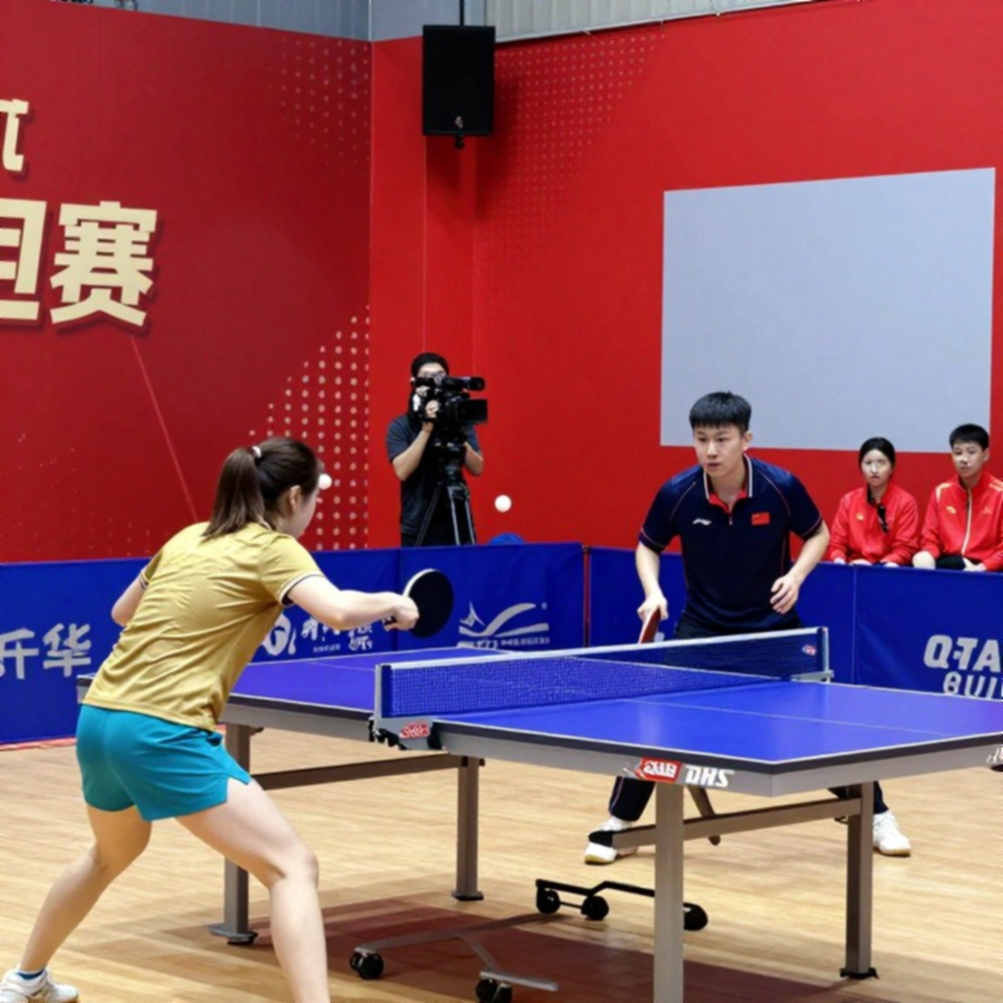
The number is not money, because the deal discloses none. The number is what has been committed. Seven cameras on Table One, four on Table Two. This is not a technical detail. It is a two-tier production model. Table One is the stage. The other tables are backstage, but still filmed. In a sport where matches run simultaneously across many tables, deciding which table gets seven cameras is deciding which story gets told. And as ever, the story told is the story of whoever paid.
Based on my experience tracking matches, this is the biggest structural difference between table tennis and team sports. In football there is one pitch, and cameras cover all of it. In table tennis, a continental championship can run sixteen tables at once in qualifying. Whoever decides which table is filmed decides who is remembered. I once watched a young player produce the match of his life on Table Five, with no camera recording it. By the next morning, nobody mentioned him.
And this is where I want to raise what I believe matters most in the whole agreement.
ETTU is not selling a tournament. ETTU is building a market-by-market power structure. In Germany it sells exclusively to Dyn. In France it has just renewed with L'Équipe, a legacy broadcaster with long standing. These are not two isolated deals. This is one model: one partner per market, one region per partner, and above them all ETTU holding the coordinating hand. Some call it fate. I call it a system that was already waiting.
Compared with the centralised model World Table Tennis (WTT) is pursuing, this is a different strategic choice at its core. WTT wants a global package. ETTU chooses regional packages. In a Europe where sports rights keep getting more expensive and streaming platforms compete viciously, splitting the product and selling market by market can yield more than selling the whole thing to one broadcaster. That is the lesson of recent years in the rights industry, and ETTU has clearly read it.
There is a small detail I think few noticed. Dyn's promotional slate includes a documentary titled Timo Boll - Der letzte Aufschlag, meaning The Last Serve. Timo Boll, the German table tennis legend, is in the final phase of his career. And Dyn chose him as its content anchor.
That says two things. First, Boll remains the single most commercially bankable figure in German table tennis, even after retirement, because his image has outgrown the table to become a cultural symbol. Second, the DACH market is entering a storytelling transition. When the narrator leaves the stage, someone has to be found. Who that successor is, and whether Dyn can build a new personality strong enough to hold subscribers, is the question this deal leaves open.
On pure competitive terms, I will say it plainly: this agreement changes nothing on the table. China is still there. European table tennis is still the second group, behind China and ahead of rising regions such as India, Brazil and Egypt. But it changes the visibility infrastructure. A German player shown more often gains higher commercial value, more sponsorship, more training opportunities. Over time that becomes accumulated advantage, and accumulated advantage is the hardest thing in sport to level out.
This is where I want to offer my contrarian read.
Contrarian angle: the deal is smaller than the headline
People read a headline about a major broadcast partnership and assume European table tennis is on the rise. The actual scope is much narrower than a hasty reading suggests. Only two events are named for 2028. The Champions League is carried only in selected stages, not in full. The content policy favours German players. Austria and Switzerland hold non-exclusive rights only, meaning fans there may see less than German fans. All of this points to a cautious structure, not a large bet.
And there is a risk nobody mentions. Dyn is a subscription platform. If it fails commercially, ETTU loses its counterparty mid-term and DACH fans lose access to their own sport. The agreement discloses no financial guarantees or termination clauses. That is an information gap, not an allegation. But it is a gap worth watching, because in the sports rights industry, emerging streaming platforms do not have a high survival rate.
What is interesting is that ETTU appears to have hedged itself. Retaining non-exclusive rights in Austria and Switzerland, alongside the parallel French renewal, creates portfolio diversity. Not all eggs in one basket. That is the behaviour of an organisation that has learned from failed deals elsewhere, and it deserves credit.
There is one further layer I want to mention, thinner though it is. Dyn runs a programme called Move Your Sport, delivered with its partner leagues, emphasising team spirit, solidarity and fair play. This is a values-marketing layer, not a measurable talent-development programme. But it shows the platform positioning itself as a cultural partner of sport, not merely a rights buyer. For a sport that needs new players in Europe, where table tennis must compete with football and esports, this layer may matter more than it appears.
One more detail: the Women's Champions League Final 4 is named only for 2027 and does not appear in the 2028 scope. That may simply be shorthand in the release, but it may also signal a priority level. In table tennis, women's events typically carry lower rights value than men's, and subscription platforms tend to concentrate resources on men's content. If that holds here, this agreement, positive overall, could deepen the gap between the two competitive systems.
Under the pressing, there is a gem nobody has picked up. In this case the gem is not a player. The gem is a structure: a continental federation daring to split its market and sell it piece by piece rather than waiting for a global package from the parent body. If the model works, other continental federations will watch and copy it. And that, over the long run, could change how sports rights are distributed worldwide, not just in table tennis.
What remains
For Vietnamese table tennis, the broadcast-infrastructure gap is still wide. The lesson, though, is close. A small sport can create its own value if it knows how to split markets, keep coordinating control, and turn its own stories into assets. The question is not how many cameras Vietnam has. The question is what story Vietnam is telling, and to whom. Because after twenty-three years in this trade, I have learned one thing: a sport does not die from a lack of stars. It dies from a lack of storytellers.